Saturday, July 9, 2011

Flam, ferries, high road, and Bergen

Today we leave Flåm after being here for 3 nights. I think we nailed it seeing everything there is to see. If you come here and do not have a lot of time, do the train, boat combo, and by all means, drive the snow road. If you are on a motorcycle, just drive around and buy some TigerBalm or BenGay so you can rub it on your neck at the end of a long day of rubber-necking.
We drove north through the loooooong tunnel again with the moon-pools every 5km to Lærdal (note the cool Norwegian character which for 10kr I will teach you how to do). We then took a really narrow 1 laner with pulloffs (man those things wear me out) to Fodnes where we took a short ferry to MannHeller. We then took Rt 55 (more 1 laner/pulloffs) to Hella and hopped another short ferry to Vangsnes. This ferry was a bit longer so I had time to go drool on an Italian guy's K1300RT (he spoke no English but told me everything about his trip and the bike in Italian (I think)). I then got to drool on a BMW 800GS with round the world stickers peeking out from under the mud on his dented and scratched alloy aluminum panniers. I got back in my diesel 4 wheeler and whimpered off the ferry. The drool on my shirt had just about dried when we got to the Hopperstad stave church in Vik that looked just like the other one at Borgond except it had more leftover 15, 16, and 17th century stuff in it. They showed us graffiti behind the altar which of course had no written words, since everyone was illiterate then, but there were lots of pictures of dragons (just to tick off the Catholics), sea dogs, and deer, but definitely lots of dragons. In the late 1800's they restored the church and included a lot of the Catholic stuff that had been taken out (some stored in nearby barns for a few hundred years and somehow not destroyed) during the Reformation in the 1500's (sent the Catholics packing and made Protestantism the official religion).
After the church it was on to my personal highlight of the day, the high road between Vik and Vinje. Not quite as nice as the snow road, but wicked decent. Not as many motorcycles up here, but lots of sheep with bells wandering around nibbling anything they could find. As you start the climb up here there is a sign telling you the road is open (just like the snow road) so I assume it closes when the snow gets too deep. How deep would that be, you might ask. All I can tell you is that the reflective markers beside the road are at the top of 10 foot high posts. Again it is barren and beautiful up here, with very little traffic. We were passed by a few bikes up there and it sure looked like fun. It is actually pretty warm so I did not see a lot of clothes on these guys other than riding suits.

I found this picture of the snow road (with a bike of course) just for reference.
So after coming down the mountain, we took the E16 all the rest of the way to Bergen. If you look at the map, the E16 looks like it would be an interstate (which is is now and then), but for the most part it is a 2 laner, and sometimes it is less (1 lane with pulloffs). We went through a gazillion tunnels today anywhere from 200 meters to 3,4,5 km long. The Norwegians pop a tunnel in just about anywhere so they must be good at it. Almost all are lit, but we found some rural ones that were one lane and dark (with sheep inside sometimes). I looked it up and Norway has more than 900 tunnels adding up to about 750km. They also have the longest road tunnel which we went through a couple times (moon pools).
We arrived in Bergen in a drizzle and quickly got lost and overshot the city and landed on the island beyond the city. The cheapo GPS app for the iPhone bailed us out and got us back into Bergen where the street to the hotel was under construction. Between this and the tunnels, the GPS app was going bananas, but we made it. There is no parking at the hotel but we can park on the street until Monday and then we have to move it to a public parking lot. We donned rain coats and walked downtown and tried a few ATMs but alas, no luck on cash. So we are hoarding our cash and exercising the credit cards which is way easy here. Everyone has tiny hand held machines that are wireless and they all take our antique, chip-less cards. We discovered today that they collect road tolls by shooting your picture, picking out your license plate, and sending you a bill (electronically I assume). I am beginning to think America is getting a little behind the times.
We had dinner at a place that sold seafood right on the dock and also cooked it if you wanted. Dinner for 2 for 255Kr is really cheap for here. That sugars out to $46. Maybe now that we are in the city, the prices will drop a bit. Slog back to the hotel and crash.

Friday, July 8, 2011

The Narrow Fjord and Steep Hike


Today we took the bus through the tunnels over to the end of the next fjord which is too narrow for the big cruise ships. We were 2 of 4 people on the bus so not sure where everyone was. We got to the town of Gudvangen where the road ends (kind of, more later) and the boat begins. There is a Viking camp there with Viking actors everywhere. Behind the cash registers, in the shops, hanging around the Viking village replica. These guys were into it and for only 10kr ($2) they would let tourists take their picture. A bunch of them were doing a fierce dance of some kind and whooping it up for a TV camera crew when we got there. So they brought the boat in and loaded us and a busload of Japanese tourists. The Japanese were from Yokohama and spoke no English, but half of the PA system messages were in Japanese. The other couple we came with were from France and very pleasant. A single older Norwegian man who also spoke no English was on the boat, and the most we could get out of him was he lived on the western coast of Norway.The narrow fjord is pretty quiet and only the smaller boats can come through. We saw a lot more of this later in the day. We got back to Flam and decided to hike a very steep trail above the narrow fjord. So we drove the car through the 2 tunnels to get to Gudvangen (deja vu) and found the one lane road on the other side of the gravel pit that leads up the side of the fjord to the town with 20 inhabitants. What is suspicious is that the boat man told us they just put a new $35M tunnel on this one lane road (that leads to 20 people) because of all the avalanches . They are up to something.
So drove to the end and headed up the hill with Deb in the lead with the backpack. Deb is a much stronger hiker and I am just out of shape so she disappeared up the hill. I got about halfway up, took a break, then realized I would never catch her, so I wimped out and came back down, laid on the beach (stone beach) and soaked my feet and tasted fjord water ( tastes like over softened water). Deb meanwhile had waited higher than me for a bit, left a water bottle for me and hiked to the top. A Swedish couple had passed me going down and told Deb I was heading down. So she got to do her hike, and I get to hang my head in shame. Time for Miller to lay off the Twinkies and get some exercise. Sorry Deb.
I hiked the lower road while I waited for Deb and found a stream that had delicious clear water, much better than the fjord. I also got to see just how quiet his fjord was when the boats disappeared. I watched some kind of otter swimming around when nobody was watching. Also snuck in a little nap. Pretty quiet.
Anyway, it started to rain just as Deb came down. She hiked 1.75 km each way (3.5 total), but climbed 740 meters, so pretty damn steep. We drove back to Flam, but missed the turn and ended up in Aurlund at the other end of the fjord. We found a nice cafe there and had dinner. Another family was there who were Americans but living in Germany. We do not normally see many Americans but in this area we are seeing a lot.
Back to the ranch to rest up for driving tomorrow. Goodbye Flam.

Trains, Bikes and Goats


We had a quick breakfast at the hotel amid a gaggle of excited youngsters. They were a big group on some kind of field trip and it looked like they were heading home.
We walked over to the train station, bought the tickets to Myrdal which included a ticket for the bikes. We rented 2 bikes from a nice guy (I could be nice in Norway for what they charge for everything), and since we had some time before the train went up the mountain, we rode down the fjord and walked the bikes 500m up the side to a farm that was really old and available to tour, get coffee and buy pancakes (they eat a lot of pancakes here). It used to be a multi-family (3), multi-generational farm and the last man held on up there until 1981 when he died of cancer. Imagine his children choosing between TV, cars, hot and cold running water and living up on this mountain with 60 some odd goats. A woman bought it after he died and has been slowly preserving it. She has been through only a few buildings (low budget operation). The house that the last man lived in has not been changed at all, as per his request so it should be more modern but it looked like he didn't go for anything new-fangled so everything was pretty old. He had a nice old radio from the 30's to liven up his evenings with Norwegian folk songs. There were 2 young women running the place. The one in charge, sort of in charge, was very quiet and shy and seemed like she had only given tours a few times and her English was so-so, but I had to smile as I quizzed her about growing up here, and learned that she was only 15. Very cute. The other woman was a college student from Finland who had never given the tour but was following the 15 year old around trying to learn what was what. I am guessing dad talked the younger one into helping out until they could get the summer student in. They did great. I like these small scale, low tech, sites. Thanks to the woman who is protecting this little peace of heaven. The barns had the standard posts tapered with flat disks carved so the mice could not climb into the barns to nibble the stores. The floors of some of the buildings had floor joists that hang below the walls. They use the crooked part of the tree as it goes out to the roots to make all kinds of interesting things. The churches did this too and I guess anything that is still working after 3000 years must be a good solution.
So back down the hill and back up the fjord to catch the famous train up the valley to Myrdal. A small herd of young guys in black jackets with red piping were riding shotgun on the tourists (that would be us). The tourist were in 2 rivers, one group from the big boat and one from the dozen or so buses. We joined the boat folks who seemed to be all Dutch and seemed like they would be more fun. They left Rotterdam a week ago and cruised all the way here. Mostly older folks, but having a great time. We sat with a trio of whom only the younger (a mere 70 or so) woman spoke much English. She was one of those people who enjoyed herself anywhere and dragged anyone she met into the fun. Very pleasant.
Speaking of old women, we kept seeing older women dressed in as much purple as they could dig out of their closets and all wearing red hats. There is some red hat society thing that people kept telling us had started in the US. Again as a demographic, these women were having fun and were not shy about it. Let's hear it for acting silly in public.
The train ride was great and the train climbed very steep tracks. I was expecting some kind of cog like setup but did not see any signs of anything but regular old tracks and wheels, so they must get enough traction somehow. I did see a box next to one of the tiny stations labelled "sand" which is a little un-nerving if you think about it. Gotta research that one.
Lots of tunnels going up and waterfall after waterfall. It takes an hour to get up, more if the train coming down is late (it was), and there are 8 or so stops at tiny stations that pickup and let off hikers and bikers. There is a road that also comes down the 20km from Myrdal, which many folks walk down all or part way. We, like others, planned to ride bikes down. We stopped for a 5 minute photo op at a huge waterfall that sprayed the crowd and the train due to the enormous amount of runoff right now. We saw pictures of the same waterfall and they were nothing like what is going on right now. This month of rain they have been having has to go somewhere..
At the top Deb bought some chocolate and we headed down the hill. We actually had to walk down the first few km of road because it is nothing more than a washed out road bed. They had tiny excavators (Kubota) parked here and there to rebuild the road. I keep seeing work sites in the middle of the week with nobody working at them, so not sure when anyone works here?
So the boulder strewn goat path (walk) turned to a steep gravel goat path (walk and ride) and we finally got down to where you could ride all the time (just plain old goat path).
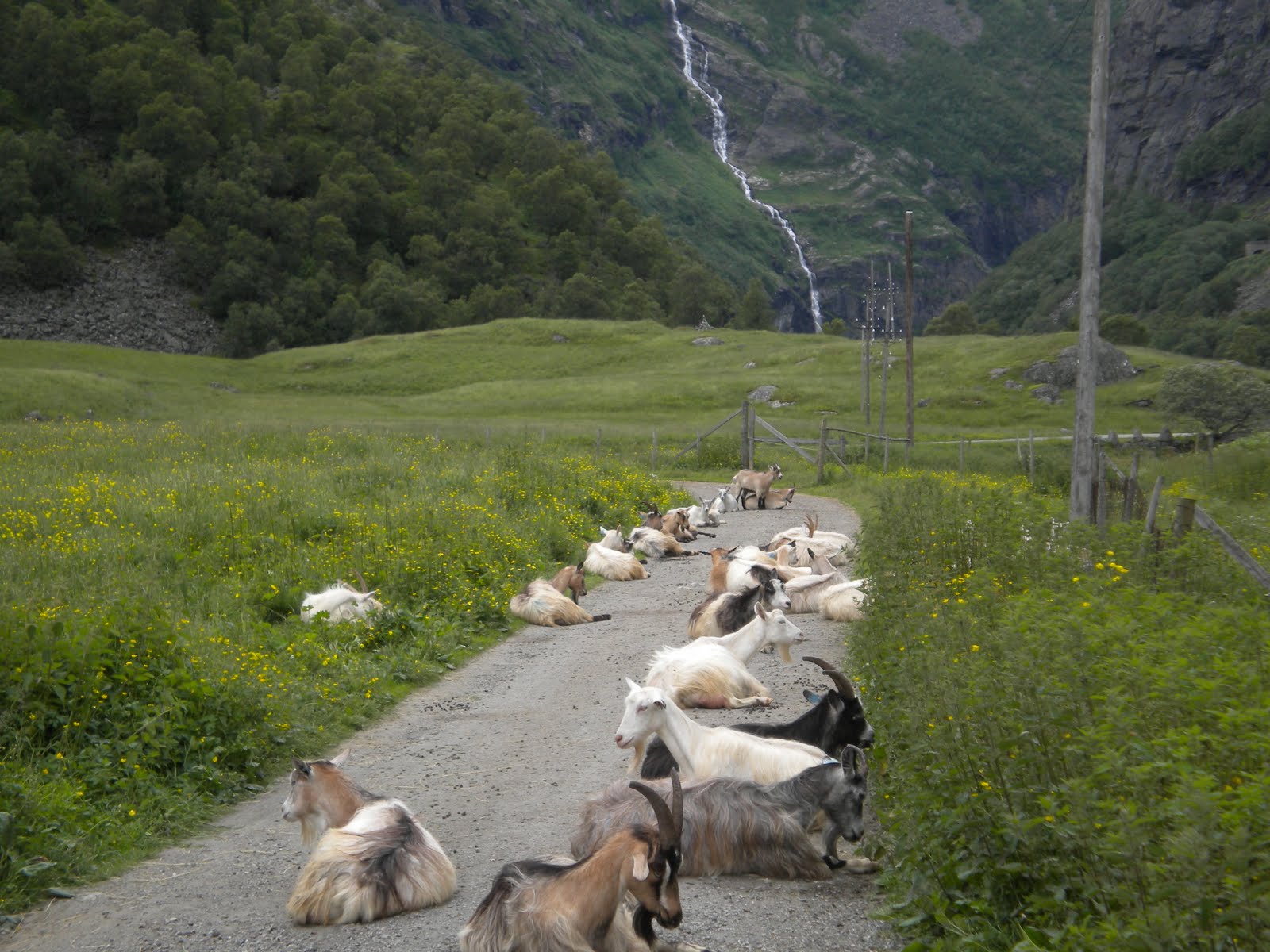
We soon had to stop because lo and behold the trail was filled with sleeping goats (about 30). Two women have a milking goat farm right between the railroad and the road. So if you have 100s of tourists walking or biking by each day, you had better start selling cheese (and pancakes), and they did. They stay up here all summer pasturing and milking the goats and making chese, then head down the hill when the weather goes bad (and the tourists are all gone). From here down the road follows a roaring river of glacial clear blue/green water. The water is so clear you could read a newspaper on the bottom of the riverbed. We passed lots of locals and tourist picnicking beside the road. There are really no cars on these roads, so they must hike or bike in to picnic. One couple built a makeshift wood fire in the stone wall and were cooking something for their lunch (goat stew perhaps?). Now and again the train would go by (up or down) with pointing fingers and cameras hanging out the windows.
We stopped at the small church in Flam that the 15 year old told us to not miss and it was very old and cozy and looked like they had regular services (stacks of Norwegian hymnals). I think they leave these buildings alone so they remain the antiques that they are.
We turned the bikes back in careful not to disturb the rental guy from washing his Rolls, and decided a burger and beer sounded great, which they happen to serve at the train station. The tourists were all gone so it was pretty quiet. Nice end to another sunny day.

Thursday, July 7, 2011

Deagali to Flam (Amazing, amazing amazing))


Woke up to the view of the high plateau with the sky bright and patched with grey overcast, probably like it is most days here from what people say. The news of the morning was that the train from Oslo to Bergen, which is the main train route across Norway, had to re-route passengers via bus becasue the tracks at washed out a short distance away. We had breakfat in the huge main room upstairs and saw the Dutch couple again and spoke briefly with the older Norwegian couple who were staying the week and sounded like they had a schedule of enjoying the solitude here above tree-line with some short car trips to local interesting places. Paid the tab, loaded the car and headed down the hill into "town", then off to finish climbing the next couple of peaks on high mountain road before descending into Geilo. This is a ski town and is on par with Lillehammer, except is not famous like Lillehammer. We tried the 2 mini-bank machines but still no luck on cash. Fortunately, bottles and cans have a 1 kroner deposti so we can pick through the dumpsters to get enough money to eat. OK, not really. None of these small banks accept plain old MasterCard ATM cards, but it appears we need a MasterCard Euro card. The debit card does work in the bigger brand name gas stations so I filled the tank (still mid 50mpg even with the mountain passes and me babying the throttle) and headed west (as much as you can up here). We followed Route 7 to Route 50 which are both spectacular high mountain roads with very little traffic. This was a surprising day because I have never thought of, or heard of Norway as having this high tundra kind of places, but it does. We did get passed by a couple of bigger trucks. The only kind of truck I have seen here says Scania (under the bugs on the front), so they must supply all the small towns up here. There are lots of sheep with bells that sort of wander all over the place and you have to keep an eye out for them up here. There are also lots of tunnels up here. One tunnel was very narrow to the point where you had to slow down and jiggle past the oncoming car when one came through the other way. The small rural tunnels have no lights inside so when you enter you need to let your eyes adjust. And of course, where do you suppose a Norwegian sheep might rest on a warm summer day but in the middle of the lane in the end of the dark tunnel. They love to lay in the end of the tunnel and combined with the darkness, it makes for some excitement if you do not slow down before you enter.
We got to our destination, Flam, by early afternoon. The fjords here are breathtaking, like the first time you see the Grand Canyon. Waterfalls coming off the sides of the fjord, the small villages at the end, and boats hauling tourists back and forth. The towns are surprisingly small and the "crop" here, probably for decades, is tourists. What is cool is that the town gets small again at the end of the day when the cruise ships leaves. They control growth really well so they have not lost the innocence and the image of the fjord. Flam has one dock and it seems like one ship pulls in every morning for milking. The mountain train goes up every hour or 2 and you can hike down or ride bikes back down. There are a few other boats you can tour the fjord on. There is the fast zodiac boat tour that looks exciting, and the big classic slow cruiser you can stop at towns along the way in. There is a bike/walking path that goes all along the fjord so you can walk or bike to the town (Aurlund) at the other end. Nicely controlled so it stays very pristeen, but they can still get a lot of people in and out. There are only a couple small hotels here so not much car traffic. The boat is the meal ticket here.
So we could not get bikes to ride back down the hill from the other end of the train, so we hopped back in the car and drove the old "snow road" between Aurland and Laerdal (can't spell it because I don't have those characters). Wow, wow and wow. This road is unbelievable.
If my brother Dave is reading this, you gotta see this road (think motorcycles!!). It climbs via one to 1.5 lane switchbacks (if someone comes the other way, you have to pull off or back up) and there is no sign in town telling you how to get on it. It is 1 to 1.5 lanes over the top and gets a bit wider way up. The road is 48km and is above treeline for the most part. There are lots of motorcycles, a few hikers, a few bicycles and believe it or not we met a couple of tour buses, and I have no idea how they make it down the switchbacks. This is what I would imagine Alaska to look like out in the tundra. Yes and there are sheep wandering around nibbling anywhere they like, and napping in the road.
Once off the snow road and back down in the valley, we drove to a huge stave church at Borgund. A college student showed us around with her flashlight (really dark inside) and told us she grew up in town and her elementary class had 2 kids in it (I assume she and one other). She is studying documentary film-making and hopes to live in Oslo when she gets out of college. She wanted to move back maybe to raise a family someday, but it might be tough sledding doing the movie thing here in Borgund.
So back to the hotel by 19:00 for dinner via the longest tunnel in the world. 25km long and it has 3 pockets that are lit up in surreal blue and yellow light just to keep people awake. They have places you can stop inside to take a break. We had dinner with an American couple from Seattle who were here for a week and heading back to Oslo the next day.
So a walk around town where we noticed the boat was gone (they apparently leave each day by 7pm) after dinner and off to bed.

Moss to Degali (Over the Alpine Hill)


Today we left the swankiest hotel to date on an island called Jeloy. Swanky but a little pretentious. We were originally going to cross over to the main part of Norway on the ferry to Horten, but decided that to save some Kroners, and I actually enjoy driving here. The plan was to drive north up the channel, fjord, bay, whatever it is called and cross over near Drobak on the bridge there. So we went north with light traffic and crossed at Drobak only to find the tunnel we were going to go through was closed (fire?). Last night we asked the lady at the ferry if the ferry was busy and she said yes because of the tunnel closing, which never registered that this was the tunnel she was talking about. So we asked a driver ed teacher having a break with his young female student (probably calming her or himself down), how to get across. His advice was to go north to Oslo and cross there. So Oslo was in the tea leaves all along, even though we were avoiding it (another city). So off to Oslo which was pretty busy, traffic wise, and then headed east into the Norwegian outback (aka boonies).
The first thing we noticed this morning was how many tunnels there are in Norway. We may have gone through 1 or 2 in Sweden but I don't remember. But Norway pops a tunnel through any place a hill or mountain gets in the way. They are anywhere from 300 meters to 15 miles long (Deb says longest in the world) which we may go through in the next few days. They must have gotten good at it. They also must be willing to pay a little (or lot) more to do tunnels instead of roads that go around and/or over. These tunnels are nice and smooth (and free) and well kept and well lit inside.
So Oslo looked like a port city with half industrial port and half cruise liner docks. We have seen a ton of cruise liners here and once you see them out on the fjords at sunset, you can understand why they like to come here to Norway. We have run into a few folks off the cruise ships and they seem to drop folks off for the afternoon with strict orders that the boat leaves at some exact time. No idea what happens if you miss the ship. I assume you pay for transportation to the next landing spot.
The other thing we had a hard time with is getting cash from the ATM machines. We tried a few before finding one that would take ours. Our daily limit is not that high so we have to be careful because of how expensive everything is here. The other issue is that our credit card does not get taken everywhere because it does not have a chip in it and the machines here do not read the strip correctly or at all sometimes, so you end up paying cash (or making a mad dash for the car before they can call the police).
We headed up into central Norway and very quickly after heading out of Oslo, encountered the wilderness. We were trying to figure out where else this country felt like and couldn't. It feels like we are travelling in Alaska (never been there but this is what we imagined) except the small remote villages there have been around for hundreds of years. There are some valleys with crops growing and small farms, but the forest is very alpine-like. We climbed and climbed up the valleys on a road that followed an old railroad bed and stopped at one of the stave churches which Norway is famous for. They used to have a thousand stave churches up until the time of the great plague (1349) that wiped out half their population. After that the number dropped and many of the churches fell down or were burned. Now there are 28 left in the whole country, and we passed 3 or 4 today. Stave refers to the wooden staves they were constructed with (basically 4 or more trees stood on end to make a really tall church). We went in one and saw the beautiful altar painted a couple hundred years ago. One of those objects that someone spends hundreds (more?) of hours on over many years and you just see how out of place beautiful it is when you see it contrasted with these rustic surroundings. Then a kid came in and said they charge 35 kroner a head to look inside the church, so we left and poked around the graveyard ($7 bucks to look inside a church seems pretty un-Christian to me). The graves covered a time period from very recent (2000's) back to the 1700's. We later found out that here they re-use grave sites after 150 years or so. If it is like home, stones did were not written on much before the 1700's and if they did it was on limestone which did not hold up. Anyway, nice church.
If my brother is reading this, this is where we should go someday to ride motorcycles. Beautiful twisty roads with roaring rivers and mountain passes. We hit the "chains required" signs as we climbed and soon were going up 7-9% grade roads over the first of what looked to be a few very high passes. We climbed above treeline to the top of the first pass and looked back at a spectacular view of the valley with its river/lake shining in the afternoon sun. From the top of the first pass we could see a broad plateau to the next pass with scrub trees and grass. There are also some seasonal cabins where people must come up to ski in the winter. We were told later that these are camps and not year-round (unless you were crazy enough to live up here year round). We were also told that they keep this road open all winter (yikes). We descended to the center of the alpine plateau and found our hotel in the tiny town of Dagali. It is only open part of the year, is very alpine town feeling and has several large gathering rooms with lots of places to sit and look out over the mountains. We went for a hike down to the raging river (they just had a solid month of rain), up a cross-country ski trail into town (wide spot with a corner store that might be in business, hard to tell), and then hiked back up the road to the church, then back to our hotel. There were only a few other people staying there, and a tour bus full of older Norwegians (bork, bork) that did not speak English as far as anyone could tell. We met a wonderful older couple from Sweden who were staying here for the week, and we befriended a couple from Holland who we exchanged questions and answers with the rest of the night (dinner was served at the hotel because there was no other place to go within many many km). They had travelled a lot and it was fun talking to them, very nice folks.
Believe it or not they do have WiFi but I am too cheap to pay 20kr ($4) for an hour!! Off to bed..

Monday, July 4, 2011

Good bye Sweden, Hello Norway

So here is the Norway moose which looks much more regal than the Swedish moose (look back a couple blogs). I still think that Swedish moose is sneaky looking..
We left Tanumshede and headed north on the E6 which was partially under construction so we followed some detour side roads which were nice. We had to use up all of our Swedish Kroners before heading into Norway, so we filled the tank. Diesel here is about $8.50 in Sweden and slightly higher in Norway. All our Kroners filled the tank. As with the plumbing, everything here is different. Green is gas and Black is diesel so I asked another customer just to make sure I was getting the right stuff in the right tank. I did not feel as stupid for asking when neither one of us could figure the gas cap (or lack thereof) on the Fiesta. Indeed there is no cap and the nozzle pushed through some kind of steel/rubber door thingy. Nice thing is you cannot lose the cap. Everything is different and handily explained in Swedish. We got our passports out expecting to need them to cross into Norway. All the usual signs were there to slow, and then slow again and then slow down again (20mph), but that was it. We never stopped, but just slowed down and then we were back to full speed on the 4 laner. They must just slow you down and look at you driving by. Works for us.
The next hurdle was getting cash in Norwegian kroners. Sweden and Denmark and Finland joined the EU, but Sweden and Denmark kept their own currency while Finland uses Euros. Norway did not join the EU (they are pretty rich with oil, so not to their advantage) and they kept their own currency. Credit cards here all have electronic chips embedded into them and everyone has a PIN number, which we do not have. Since we are staying in out of the way places, not used to Americans, it is a bit difficult to use debit and credit cards. Not horrible, but you have to go from bank to bank until one of them works. This was the case here. Also English is a little tougher here, but still not too bad. Much better than our Norwegian for sure.
We stopped in Fredrikstad which is a restored 18th century village they put together as original as possible and then hid shops inside the buildings so you couldn't tell from the outside. The town was a garrison with cannon and all for a few hundred years. Most of the plaques talk about attacks from the Swedes and one final tense moment in 1902 when Norway asked for a divorce and got it. We also stopped at Halden and toured around another fort on a hill with much the same story. War has defined peoples spare time and maybe someday we can use the human and financial resources for better things. When you see these old towns you realize that whoever is attacking who, life sort of goes on, maybe under a different flag or currency, maybe a little better or a little worse, but everybody still gets up in the morning, kisses their kids, makes the donuts and goes back to bed each night. OK, I am done with that..

We got to our hotel and checked in. Left is the view from our balcony of the fjord (I think it is a fjord). The restaurant here was a tad expensive so we headed in to town to ask around and explore. We were told of a great spot where a lot of locals seem to meet and had a great meal. We strolled down along the boardwalk near the water where all the boats were coming in. We had been told that Norway encourages more immigration than Sweden and at least in this town you can see a lot more ethnic diversity. Quite a few women with head coverings and the guy working at the ice cream place was from Afghanistan. He says American is "King of the World with our B-52s". Not sure where to go with that but it sounded friendly.
The sun sets here at 10:30pm and rises at 4am, so the days are nice and long. I babied the Fiesta today and was averaging over 60mpg, but ended the day at around 58 mpg. I like these little diesels...

Sunday, July 3, 2011

Quaint, really quaint and quaint++ fishing villages

Today's mission is to drive down the coast and see fishing villages, and we have good news and bad news. But first, we stopped by the local UNESCO World Heritage site in Tanumshede (where we're staying) to see rock carvings from 1000BC or so. As you would expect, you go into these exhibits / parks not too excited about it (oh boy, rock drawings..) and come out with an appreciation of how far we have come, or not.. The ocean was higher so there was water where there are now farms. These folks did not yet have written language so they drew pictures. There was gobs of god stuff, horses dragging the sun around, etc, which helped explain the unknown, as more religions did/do. These guys happened to scrawl their stuff on rocks with other harder rocks and now it is up to anthropologists (detectives) to try and figure out what they were trying to say. It is important to stand there looking at something someone scratched out 3000 years ago and see them as not much different then yourself (food, shelter, family, worry, status, all the same things but we have different stuff (cars, houses, iPods,...). The other interesting side note is that due to the sulpher and nitrogen from industrial pollution (specifically a 2011 Ford Fiesta Diesel Car), the rock is breaking down and they are starting to cover them up so they do not erode. Same thing we heard about the Roman ruins and same reason Lincoln's nose hairs at Mt Rushmore stopped growing (made that one up).
We rented bikes to go visit those spots and the first bike I got had really loose handlebars so they got me the wrong wrench, then another bike that was not there, so they felt bad, gave us something free from the gift shop cause they felt bad, and then I got a working bike.

So then we headed down the coast to see the villages on the shore. It was Sunday so there were a lot of folks doing the same thing. We hit town after town, finding the free parking lot (usually a short walk from town), walking in and wandering around until we did (or did not) find the center of town, back to the car, and off to the next town. So the verdict is that my favorite town was Grebbestad which got high marks because it had the most normal working Swedes on Holiday there. Also high points for not having any Ferrari 458 Italias or Porsche GT2 RS's in them. Most of the rest have been over run with pretty rich folks that buy the quaint little towns up and make them even more quaint. The main thing to notice is the lack of fishing boats, which Grebbestad had plenty of, good scratched up, well loved fishing boats at that. The fishermen there apparently organized to keep the tradition alive there some how.
The village that was the most quaint (not too over the top) was Fjallbacka. Another nice one that everyone raved about, very rich, but also had the nicest rock islands (picture above) was Smogen.
At around 5pm we headed back north a slightly different way seeing a few more small villages, and once wandering off down a dirt road to find not much. I was hoping to find the Swedish trailer parks but I don't think there are any (remember socialist country, 45% taxes, etc..). The dumpiest houses we have ever seen would be well insulated, painted red, etc. A lot of people live in apartments here as well. All of these fishing villages are connected with a bus system so you can get back and forth.

We ended up back in Grebbestad and got good old American cheeseburgers at a place famous for tuna (go figure). Then an after dinner stroll down the boardwalk to inspect the fishing boats and then drive back home to the Hotel. Good and tired again, so off to bed so we can get up early and leave to cross into Norway in the morning. Maybe Oslo but there is another cool town Fredrickstad we may explore. Oh yea, 51MPG today, gotta love it. Diesel is 13.74 Kroner per liter which sugars out to $2.18 per liter so $8.25 per gallon. Stop your whining about high fuel prices!!